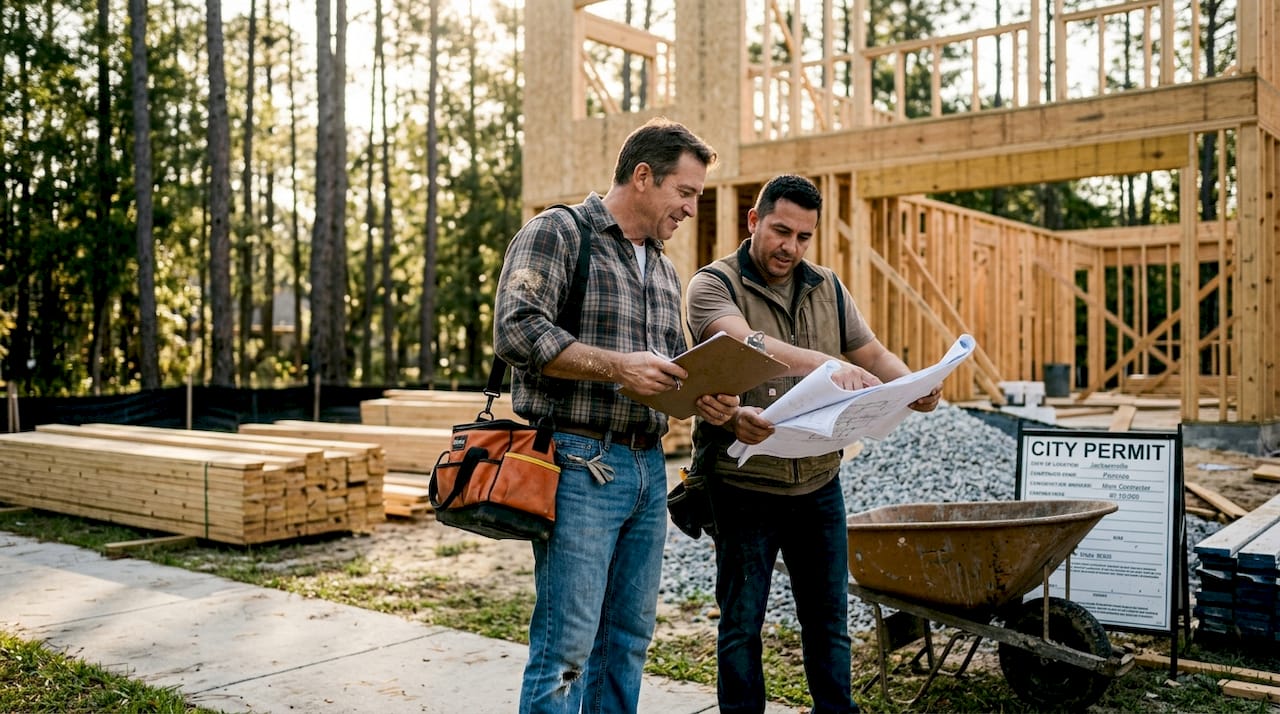
Walking into a permit office or sitting across from a contractor in Jacksonville can feel disorienting when the conversation shifts to setbacks, lot coverage, certificates of occupancy, or FEMA flood-zone designations. Most homeowners and property investors have strong instincts about what they want to build, but unfamiliar terminology can lead to miscommunication, costly revisions, and unnecessary delays. Jacksonville’s local zoning code, permitting structure, and construction language carry specific nuances that differ from other Florida markets. This guide breaks down the core terms you will encounter at every stage of a residential project, from initial site assessment through final inspection, so you can engage with contractors, planners, and permit officials with confidence.
Table of Contents
- Essential construction terms every Jacksonville homeowner should know
- Local rules: Navigating zoning, setbacks, and lot coverage in Jacksonville
- Permits and inspections: What every project in Jacksonville requires
- The fine print: Expert nuances and exceptions in Jacksonville code
- Our take: Why knowing the lingo is your best tool in Jacksonville construction
- Ready to build smart? Get expert help for your Jacksonville project
- Frequently asked questions
Key Takeaways
| Point | Details |
|---|---|
| Master key terms | Knowing local construction lingo makes communication smoother and helps prevent costly mistakes. |
| Understand local rules | Jacksonville-specific terms like setbacks and lot coverage directly shape your building choices. |
| Comply with permits | Grasping the permit process and validity keeps your project legal and on schedule. |
| Watch out for code nuances | Expert advice on permit deadlines and exceptions avoids hidden fees and delays. |
Essential construction terms every Jacksonville homeowner should know
Now that you see why getting familiar with the ‘language’ is essential, let’s break down the key terms you’ll encounter from day one. A solid working vocabulary helps you read contracts accurately, ask sharper questions, and catch misalignments before they become expensive change orders.
According to industry terminology guides, the most frequently referenced general terms include aggregate, beam, blueprint, foundation types, green building (such as LEED-certified design), and surveying. Each plays a direct role in Jacksonville residential projects.
- Aggregate: Sand, gravel, or crushed stone mixed into concrete. In Jacksonville’s coastal soil environment, aggregate selection affects both strength and drainage performance.
- Beam: A horizontal structural member that transfers loads to vertical supports. Beam sizing is dictated by span length and load calculations in your engineer’s drawings.
- Blueprint: The complete set of design drawings, including floor plans, elevations, and structural details, submitted to the city for permit approval.
- Foundation: Jacksonville sites typically use slab-on-grade or raised foundations depending on soil bearing capacity and FEMA flood-zone requirements.
- Green building: Design and construction practices meeting recognized sustainability standards. LEED certification, for example, can affect material specifications and subcontractor selection.
- Surveying: The precise measurement and mapping of a parcel’s boundaries, elevations, and features. A current survey is required for most permit applications in Jacksonville.
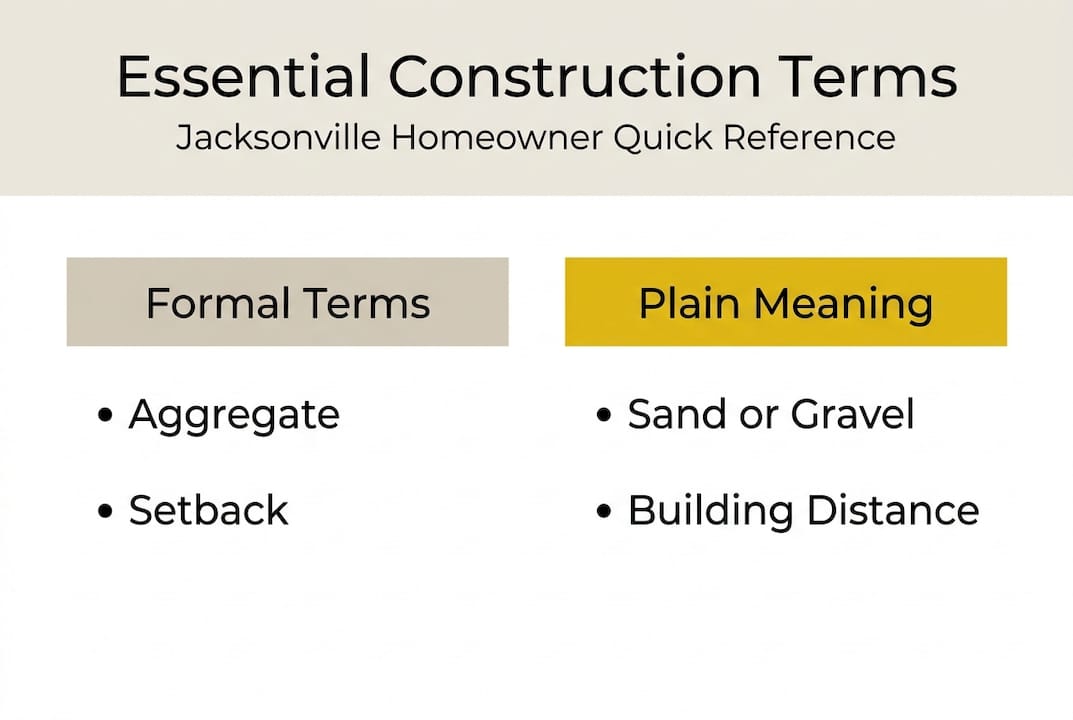
The table below offers a quick-reference comparison so you can move from formal terminology to plain language and understand why each term matters locally.
| Formal term | Plain-language meaning | Local relevance in Jacksonville |
|---|---|---|
| Aggregate | Sand or gravel in concrete mix | Coastal soil and drainage conditions affect mix design |
| Beam | Load-carrying horizontal member | Span requirements vary with open floor plan designs |
| Blueprint | Full set of design drawings | Required for permit submission to Jacksonville BID |
| Foundation | Structural base of the building | Flood zone and soil type determine the appropriate type |
| Green building | Eco-efficient construction standard | May qualify for local incentives or expedited review |
| Surveying | Legal land measurement and mapping | Mandatory for setback compliance verification |
For a broader overview of the construction service terms applied in local projects, it helps to review how each definition connects to the scope of work before signing any contract. You can also reference a detailed shed construction terminology breakdown for smaller accessory structure projects where some of these same terms apply at a reduced scale.
Local rules: Navigating zoning, setbacks, and lot coverage in Jacksonville
Understanding the language is just the start; the next step is to see how local rules directly shape your options. Jacksonville’s Consolidated City-County structure means zoning regulations are administered citywide, and the specific district classification of your parcel controls what you can build, how large it can be, and where on the lot it must be positioned.
The City of Jacksonville defines several terms that appear in nearly every residential application. Key local terminology) includes setbacks, lot coverage, FEMA flood-zone designation, and zoning districts that dictate permitted uses, densities, and building heights.
Here is a plain-language breakdown of the most important local zoning terms:
- Setback: The minimum distance required between any part of your structure and a property line. Front, rear, and side setbacks differ by zoning district, and even a minor encroachment can trigger a mandatory variance process.
- Lot coverage: The maximum percentage of your lot that can be covered by impervious surfaces, including the building footprint, driveways, and patios. Exceeding this limit requires either a redesign or a variance application.
- FEMA flood-zone designation: Properties in designated flood zones must elevate the lowest finished floor above the Base Flood Elevation (BFE). This directly affects foundation design and overall building cost.
- Zoning district: The classification assigned to your parcel (for example, RR, RLD-60, or RMD-A) that determines what uses, densities, and structures are allowed by right.
- Floor area ratio (FAR): The ratio of total building floor area to lot area, which caps how large a structure can be relative to its site.
| Zoning factor | Typical residential requirement | Practical impact |
|---|---|---|
| Front setback | 20 to 25 feet in most RLD districts | Limits how close the garage or porch can be to the street |
| Side setback | 5 to 7.5 feet typical | Constrains additions and attached structures |
| Lot coverage | 35% to 50% depending on district | Controls total hard-surface area on the parcel |
| Flood zone BFE | Varies by FIRM panel | Raises foundation and increases construction cost |
Pro Tip: Before finalizing any site plan, use Jacksonville’s zoning services portal or contact the Planning Department directly to confirm your parcel’s exact district classification and overlay zones. Many homeowners assume a project fits within allowable limits only to discover a floor area or coverage issue after permit submission, which resets the entire review clock.
Permits and inspections: What every project in Jacksonville requires
Once you’ve grasped what you can build and where, it’s time to decipher Jacksonville’s permit process from start to finish. Permits are not just administrative paperwork; they are the mechanism through which the city verifies structural, electrical, plumbing, and life-safety compliance at each phase of construction.
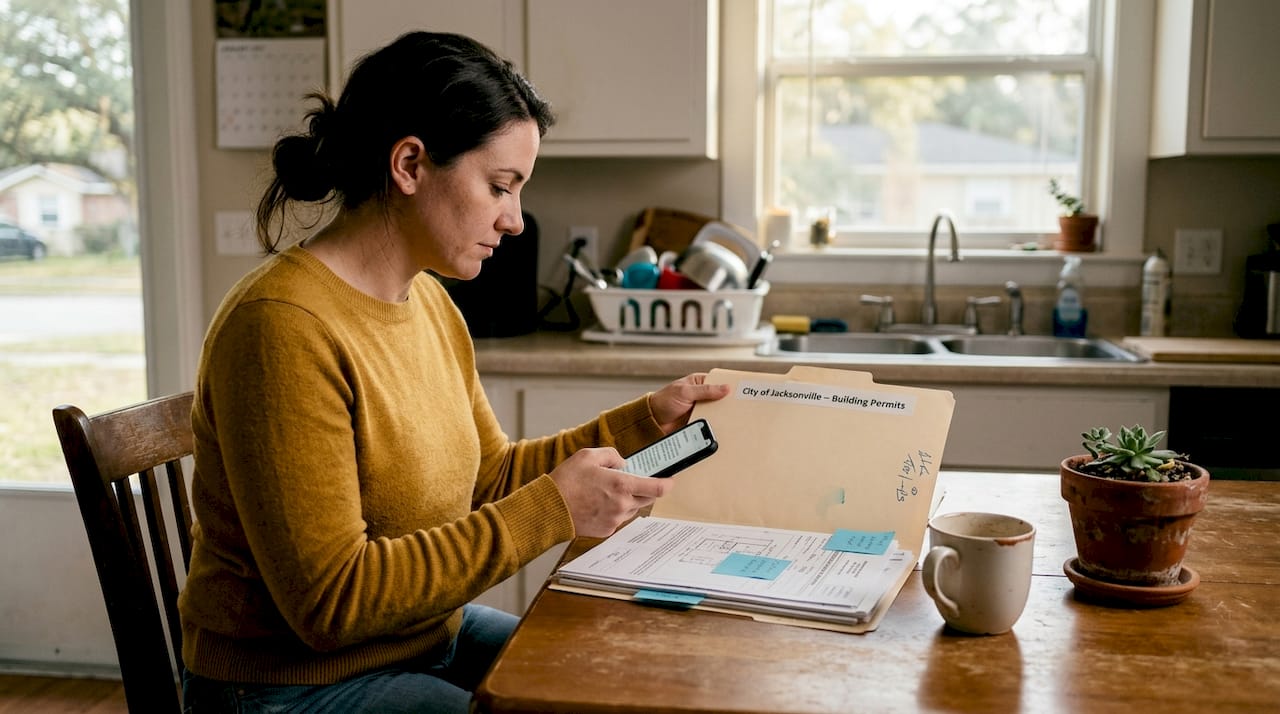
For residential projects in Jacksonville, permits are issued through the Building Inspection Division (BID). Residential cost benchmarks show custom builds range from $200 to $350 per square foot for mid-range construction, reaching $400 or more in coastal areas, with project timelines running 14 to 20 months. Permit fees are calculated at approximately $6.38 per 100 square feet of enclosed new construction, though additional fees apply for mechanical, electrical, and plumbing sub-permits.
The standard permit process for a new residential build or major remodel follows these steps:
- Pre-application review: Confirm zoning compliance, verify setbacks and lot coverage, and obtain a current survey.
- Plan preparation: Engage a licensed architect or engineer to produce permitted drawings per Florida Building Code requirements.
- Application submission: Submit drawings, site plan, energy compliance forms, and applicable fees to Jacksonville BID online or in person.
- Plan review: The city reviews for structural, fire, zoning, and energy compliance. Review times average two to four weeks for residential projects.
- Permit issuance: Once approved, the permit is issued and must be posted on site before any work begins.
- Staged inspections: Inspections are required at framing, rough-in (electrical, plumbing, mechanical), insulation, and final completion.
- Certificate of occupancy (CO): Issued after a successful final inspection, the CO authorizes legal occupancy of the structure.
Pro Tip: Track your remodeling permit requirements carefully against the permit validity window. If work stalls and an inspection does not occur within the validity period, you may face re-application fees. Reviewing project timelines in Jacksonville before committing to a construction schedule helps set realistic expectations and prevents costly permit lapses.
The fine print: Expert nuances and exceptions in Jacksonville code
Even if you master the basics, small details in local codes can have outsized impacts. Let’s zero in on what most guides miss, because these nuances are precisely where projects get delayed or costs spike unexpectedly.
The most significant procedural detail in Jacksonville’s permitting system is the validity period. Permit validity rules) specify that permits are valid for 180 days and reset with each successful inspection. Unpermitted work discovered after the fact doubles the applicable permit fees. Zoning variances are required for any deviation from code-prescribed limits, including home businesses that occupy more than 25% of the structure’s total floor area.
Several situations fall into a gray area that surprises even experienced property owners:
- Running a business from home: Permitted under certain conditions, but the business activity cannot exceed 25% of the home’s total floor area, and no external signage or customer traffic is typically allowed in residential zones.
- Building in a FEMA flood zone: Required elevation above the Base Flood Elevation may necessitate a Flood Elevation Certificate before permit issuance and after construction completion.
- Accessory dwelling units (ADUs): Allowed in some Jacksonville districts but subject to separate setback, coverage, and utility connection requirements.
- Historic overlay districts: Properties within designated historic areas face additional design review before standard permits can be issued.
- Garage conversions: Converting an attached garage to living space requires a full building permit and may affect the home’s required parking count under local code.
Expert insight: The 180-day permit clock does not pause for weather delays, contractor disputes, or material shortages. If your project goes dormant and no inspection is logged within that window, the permit expires and you must re-apply, paying fees again. Proactive scheduling of inspections, even for partial work completions, protects your permit status and keeps the clock reset.
For guidance on navigating these situations, reviewing the remodeling and zoning tips available through a licensed local contractor helps clarify which exceptions apply to your specific parcel and project scope.
Our take: Why knowing the lingo is your best tool in Jacksonville construction
Having covered the landscape of local terminology, here’s what experience teaches us about its real power. Over 15 years working on residential projects across Jacksonville, the clearest pattern we observe is this: homeowners and investors who arrive at permit meetings, contractor negotiations, and zoning hearings fluent in the relevant terminology consistently achieve faster approvals and more favorable outcomes.
This is not simply about compliance. When you can articulate the difference between lot coverage and floor area ratio, or reference a specific FEMA flood-zone requirement with precision, permit reviewers and contractors treat the conversation differently. The project moves from negotiation to execution more quickly.
Consider two otherwise identical projects: one owner submits a plan without accounting for a flood-zone BFE requirement; the other owner addresses it proactively in the initial application. The first owner faces a revision cycle that adds four to six weeks and additional engineering fees. The second owner receives approval on the first review cycle. The only material difference was knowledge of the applicable terminology and its implications.
Insight from commercial construction basics reinforces this at every scale: precise language reduces ambiguity, and reduced ambiguity shortens timelines. Apply what you’ve learned here to every contractor conversation and permit interaction, and you will see measurable differences in how smoothly your project progresses.
Ready to build smart? Get expert help for your Jacksonville project
If you’re looking to make your Jacksonville construction project as smooth as possible, here’s where to turn for professional assistance. Understanding terminology is a strong foundation, but executing a code-compliant, well-managed project requires local expertise across permitting, structural design, and construction management.
Ofir Engineering (license CHC1540016) brings over 15 years of Jacksonville-specific residential construction experience to every project. Whether you are pursuing new construction services for a custom home, need home remodeling help for a full renovation, or are exploring durable steel frame construction systems for your next build, the team provides precise guidance from initial planning through certificate of occupancy. Reach out today to discuss your project scope and get clarity on every term that matters.
Frequently asked questions
What does ‘setback’ mean in Jacksonville construction?
A setback is the minimum) required distance between any part of a structure and a property line, as defined by Jacksonville’s zoning district rules. Setback distances vary by district and by which property line (front, rear, or side) is being measured.
How long is a construction permit valid in Jacksonville?
Permits are valid for) 180 days from issuance and are effectively renewed each time a successful inspection is logged during active construction. If no inspection occurs within that 180-day window, the permit expires and re-application is required.
How much does it cost to build a custom home in Jacksonville?
Custom home costs typically range from $200 to $350 per square foot for mid-range construction, with coastal projects commonly reaching $400 or more per square foot depending on flood-zone and site requirements.
What happens if I do not get a permit for construction in Jacksonville?
Unpermitted work doubles) the applicable permit fees when discovered, and the work may also need to be exposed, inspected, or partially demolished for compliance review, adding significant time and cost to the project.
What is a zoning variance and when do I need one?
A zoning variance is a formal exception to local code requirements, required for deviations) such as home businesses occupying more than 25% of total floor area or structures that cannot meet standard setback or lot coverage limits. The variance process involves a public hearing before the Zoning Board of Appeals.
Recommended
- Service – Ofir Engineering
- Commercial Construction – Ofir Engineering
- 1476 W 23rd ST, Jacksonville, FL 32209 – Ofir Engineering
- 10131 Fair CT Jacksonville FL, 33219 – Ofir Engineering
- Civil construction trends shaping Auckland projects for 2026
